Of all the stories woven into the history of Coastal Virginia and Coastal North Carolina, none has captured imaginations quite like the Lost Colony of Roanoke. More than four hundred years after 115 English settlers vanished from Roanoke Island, we still do not know with certainty what happened to them. The Lost Colony is often called America’s greatest unsolved mystery, and the island where it unfolded sits right here in our region, less than two hours from Virginia Beach. This week’s local history spotlight takes us into one of the oldest and most haunting stories in American history, perfectly timed for the week leading into Halloween.
The story begins in 1587, decades before Jamestown and more than three decades before the Pilgrims. A group of 115 English colonists arrived on Roanoke Island off the coast of what is now North Carolina, led by John White, an artist and administrator appointed governor of the new colony. The settlers included men, women, and children, and they came intending to build a permanent English settlement in the New World. The colony was Sir Walter Raleigh’s second attempt at colonizing the area. An earlier military expedition had failed and left the island in 1586, so the 1587 group was starting largely from scratch.
Shortly after the colonists arrived, two significant things happened. First, a child was born. On August 18, 1587, Virginia Dare became the first English child born in the Americas, the granddaughter of Governor John White and the daughter of Eleanor and Ananias Dare. Her name honors Virginia itself, and her story has become one of the most enduring in American folklore. Second, the colony recognized that it would not survive the coming winter without additional supplies from England. John White, as governor and now grandfather, agreed to make the voyage back to England to secure provisions and reinforcements. He expected to return within months.
He did not return for three years. Shortly after his arrival in England, the Anglo-Spanish War escalated, and Queen Elizabeth I ordered every available ship to defend England against the Spanish Armada. The war delayed John White’s return again and again. When he finally made it back to Roanoke Island on August 18, 1590 (ironically his granddaughter’s third birthday), the colony was gone. The buildings had been dismantled rather than destroyed, suggesting the settlers had left intentionally. There were no signs of struggle. And carved into a post of the fort was a single word: “CROATOAN.” Carved on a nearby tree were the letters “CRO.” The two carvings have been debated by historians for over four centuries.
Croatoan was the name of a nearby island (now Hatteras Island) and the name of a native tribe that had been generally friendly to the English settlers. The colonists had previously agreed with John White that if they left Roanoke Island, they would carve the destination of their departure, and that if they were forced to leave under distress, they would carve a Maltese cross as a warning. The CROATOAN carving had no cross, suggesting the colonists moved voluntarily. White was prevented by weather and ship conditions from investigating further, and he never returned to search again. The colonists’ fate was never definitively confirmed.
Theories about what happened to the Lost Colony have ranged across four centuries. The most widely held theory today is that the settlers integrated with the Croatan or other native peoples, moving inland and eventually blending into the broader indigenous population of coastal North Carolina. Supporting this theory are documented later accounts of native peoples with lighter skin, European features, and words of English origin in their languages. The Lost Colony DNA Project has worked for years to find definitive genetic evidence of this connection. Other theories include the colonists being killed by rival native tribes, dying of disease or starvation, or attempting to sail to England or the Chesapeake Bay and being lost at sea. Recent archaeological work on both Roanoke Island and Hatteras Island continues to turn up intriguing but inconclusive evidence.
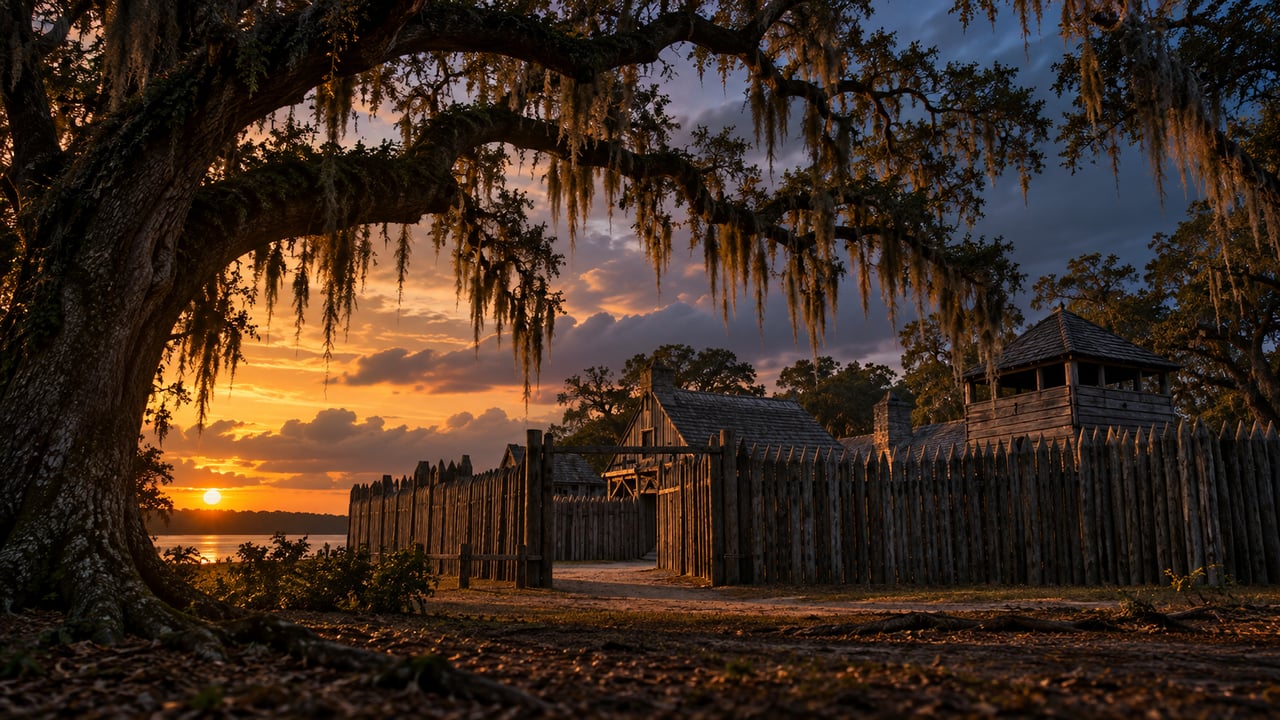
Today, Fort Raleigh National Historic Site preserves the location where the colony stood, with a visitor center, nature trails, and an area with a reconstructed earthen fort. The adjacent Waterside Theatre has hosted “The Lost Colony,” one of the longest-running outdoor dramas in American history, every summer since 1937. The Elizabethan Gardens, right next door, honor the memory of the colonists with beautiful period gardens overlooking Roanoke Sound. All three sites sit within a short drive of each other on Roanoke Island, just a few miles from downtown Manteo, and visiting them in sequence gives you the fullest sense of what happened here that no history book quite captures.
For anyone who lives in Coastal Virginia or Coastal NC, visiting Fort Raleigh and the Elizabethan Gardens is one of the most meaningful experiences our region offers. Standing on the ground where 115 English colonists lived, worked, and vanished, where the first English child born in the Americas was baptized, where John White returned to find his family and his colony simply gone, is a powerful thing. The Lost Colony is not a legend. It is our shared regional history, and it is still here waiting to be experienced.
Our Thrive Realty team lives and works across Coastal Virginia and Coastal NC every day, and we love being part of a region with this much history running through it. Watch for the next local history spotlight coming, which will take us to another corner of our region worth knowing about.