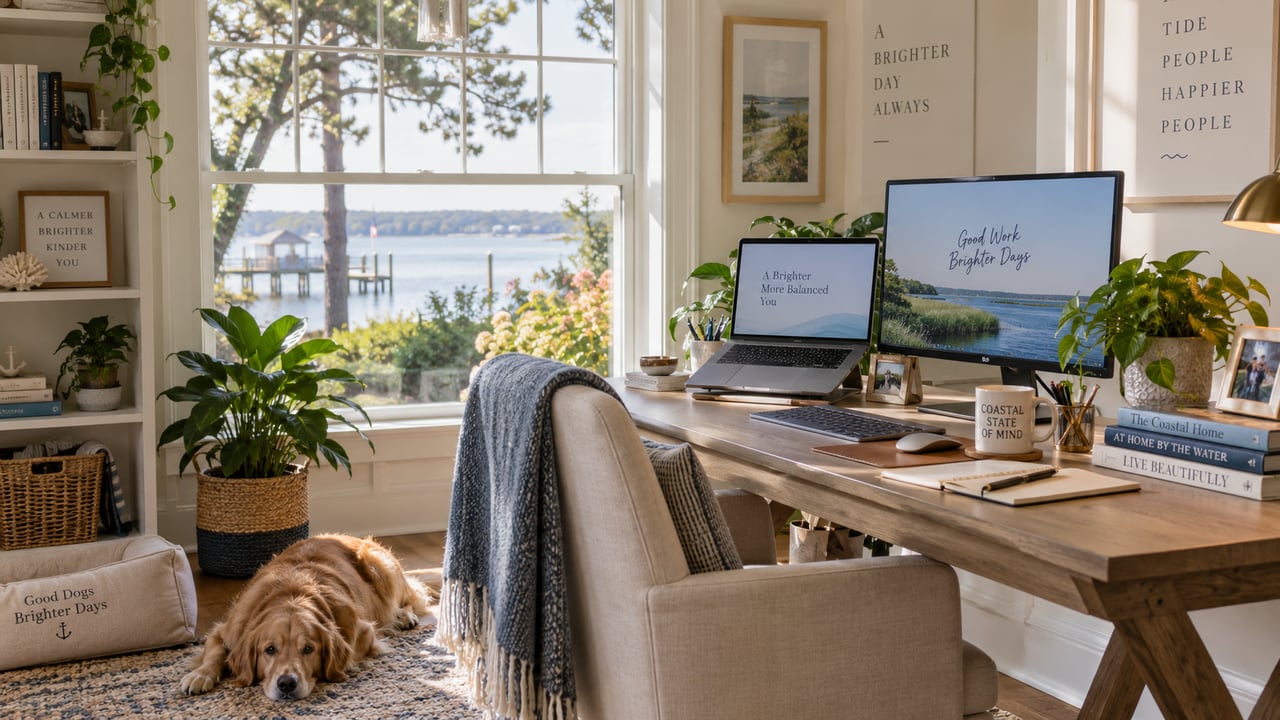
Remote work has settled from a pandemic-era experiment into a real and lasting part of how many households live and work. Coastal Virginia and Coastal NC have quietly become popular destinations for remote workers who want the coastal lifestyle without giving up their careers. If you are buying a home while working remotely, or planning to, the criteria you need to prioritize look meaningfully different from a standard home search. Buying a home for remote work in Coastal Virginia is worth thinking through carefully, because the wrong home can quietly wear on your productivity and your mental health week after week.
The single biggest question to answer honestly is how much dedicated workspace you actually need. A corner of a bedroom might work fine for occasional remote days. A full-time remote job usually requires a real office with a door that closes, especially if you take video calls, deal with sensitive information, or share a home with kids, roommates, or a partner who also works from home. Two-remote-worker households often need two separate spaces, since simultaneous video calls in the same room quickly become miserable. Look at homes with an eye toward how they can actually function on a Monday morning at 10 am, not just how they look during a Sunday afternoon showing.
Internet reliability is not glamorous, but it is the single most important infrastructure question for remote workers in Coastal Virginia and Coastal NC. Most of the 757 has strong fiber and cable options, but coverage can vary significantly by neighborhood and even by street. Rural pockets of Suffolk, Chesapeake, Currituck County, and much of the OBX outside of the main commercial corridors sometimes have more limited options. Before you fall in love with any home, look up specifically which internet providers serve that address and what speeds are actually available. Ask the seller about their current internet service and typical performance. If you rely on video calls or bandwidth-heavy work, do not assume that "internet is available" means "internet works well."
Layout considerations extend beyond just the office itself. Think about noise flow through the home. Is your potential office next to the kitchen where household life happens? Is it next to a busy street or a construction site? Does the home have hard floors that amplify sound, or soft surfaces that absorb it? Natural light matters more than most buyers realize until they have spent months working in a dim room. Windows, ceiling height, and how the room feels at different times of day all shape the reality of remote work life. Homes with a first-floor office space near an entrance are especially useful if you occasionally meet clients or vendors at home.
Location strategy shifts meaningfully for remote workers. Since you are not commuting to a Coastal Virginia office five days a week, you have more flexibility to prioritize lifestyle, community, and value. Some remote workers move to Kitty Hawk, Duck, or Corolla for full-time OBX life. Others choose historic neighborhoods like Ghent, Hilton Village, or Olde Towne Portsmouth for walkable community feel. Others find great value in Suffolk, western Chesapeake, or Moyock, where they can get more house and more land per dollar without needing to worry about a daily commute. Match your neighborhood choice to how you actually want to live rather than to where you would have needed to live if you commuted.
There are also a few practical considerations worth naming. HOA rules occasionally include restrictions on running a home business, so review the covenants carefully if you are considering an HOA community. Tax implications for a home office deserve a conversation with your accountant, especially if you plan to claim a portion of the home as business expense. Zoning can matter if you plan to see clients at your home. Homeowners insurance may need adjustments if you have significant business equipment or inventory in the home. These are all manageable, but they are worth thinking through before you write an offer rather than after.
Remote work has genuinely changed how people choose where to live, and Coastal Virginia and Coastal NC are wonderful places to build a remote work life with the right home behind you. Our Thrive Realty agents help remote workers find homes that actually fit their working reality across every neighborhood we serve. If you are thinking about a move or a remote work lifestyle upgrade, we would love to help you think through what a home should look like for your specific work life. Reach out whenever you are ready.